🎯 Efficient Frontier — Guide
“Find the mix that thrills you without keeping you up at night.”
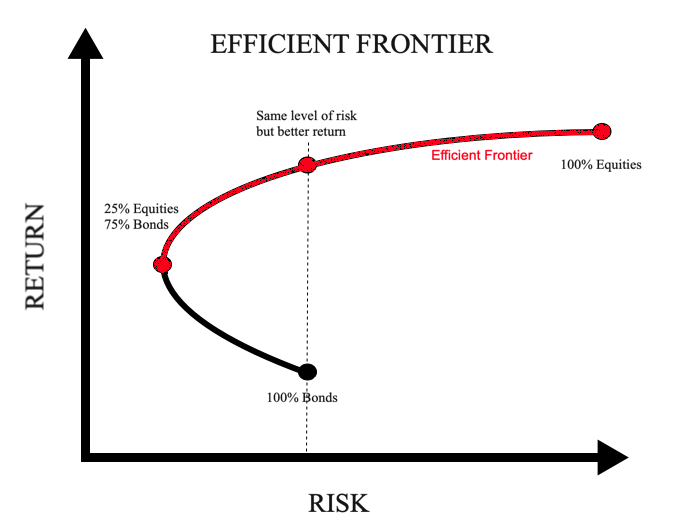
📌 1 What on earth is an efficient frontier?
Picture every possible portfolio of your chosen assets on a two‑axis chart:
- X‑axis: annualised volatility (risk)
- Y‑axis: expected annual return
Most dots live in the middle. The efficient frontier is the upper‑left edge of that cloud — the set of portfolios that deliver the highest return for a given level of risk (or, flipped around, the lowest risk for a chosen return).
If your portfolio sits below that curve, you’re either leaving money on the table or accepting more stress than necessary.
💡 2 The intuition before the equations
- Diversify: mix assets that don’t move in perfect lock‑step.
- Risk–reward trade‑off: extra risk can buy extra return, but not automatically.
- Optimise: let math churn through millions of weight combinations and keep only the “best so far”.
That’s the whole trick. No black magic required.
📐 3 A pinch of maths (kept gentle)
For a portfolio with weights w, the expected return \( \mu_p \) and volatility \( \sigma_p \) are
where
- \( \boldsymbol{\mu} \) — vector of mean asset returns
- \( \Sigma \) — covariance matrix of those returns
To trace the frontier we repeatedly solve:
(Here we forbid short‑selling. Remove \( \mathbf{w} \ge 0 \) if you’re fine with shorts.)
🧪 4 Doing it in code (five lines, promise)
ef_returns, ef_vols = construct_efficient_frontier(
    returns=my_returns,      # DataFrame of daily % returns
    tickers=my_tickers,
    num_points=100
)

PortfolioPlotter.plot_efficient_frontier(
    port_vols, port_returns, sharpe,
    ef_vols, ef_returns, max_idx
)
construct_efficient_frontier loops over 100 target returns, feeds each optimisation to cvxpy, and stores the resulting risks.
plot_efficient_frontier colours random portfolios by Sharpe ratio so you can spot the sweet spot instantly.
🖼️ 5 How to read the picture
- Black line: efficient frontier
- Red dot: portfolio with the highest Sharpe ratio among the random samples
- Sea of dots: random portfolios — most are, frankly, mediocre
Slide leftwards until lowering volatility starts to shave more return than you’re willing to lose. That’s usually your “happy place”.
✅ 6 Quick checklist
- [ ] Use at least three years of daily data (more is better).
- [ ] Annualise returns and volatilities (* 252) consistently.
- [ ] Inspect the covariance matrix for weird outliers.
- [ ] Decide on constraints (no shorts? max weight per asset?).
- [ ] Run the backtest after fixing weights; don’t peek at the future.
📚 Further reading
- H. Markowitz — Portfolio Selection (1952)
- Grinold & Kahn — Active Portfolio Management
- Quantocracy blog posts on efficient‑frontier visualisations
(This guide is for educational purposes only — not investment advice.)